ACOS network data flows include system network data flows and VM network data flows.
ACOS provides management services, storage services, migration services, and access services. Each service uses its own system network to transmit data flows.
System network traffic includes egress traffic and ingress traffic, and communicates with other nodes or clients through the ACOS host network protocol stack (TCP/IP Stack).
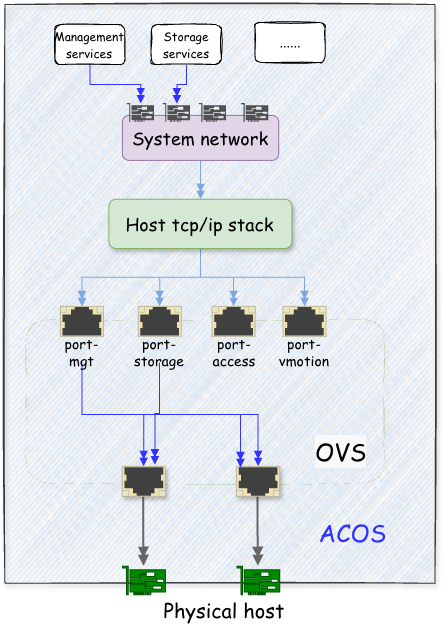
This section uses the management service as an example to describe how ingress and egress traffic is forwarded for a system network. Other types of system networks follow a similar workflow.
When a user performs management operations on ACOS, access requests are sent to the ACOS management service through the management network. After receiving an access request, the management service responds to the request through the management network. During this process, the paths and processing methods of ingress and egress traffic of the management network are as follows:
Egress traffic of the management network
Packets sent by the management service are sent through the management network to the host network protocol stack (TCP/IP Stack) for processing, and then sent through the virtual port (port-mgt) created for the management network to the OVS bridge on the host. Based on information such as the VLAN ID and destination MAC address of the packets, the OVS bridge sends the packets to the corresponding physical network port on the host, and then forwards them to the physical switch for further forwarding.
Ingress traffic of the management network
When a user accesses the management service, packets are first forwarded through the physical network and enter a physical network port on the host through the physical switch. The physical network port forwards the packets to the OVS bridge on the host. Based on information such as the VLAN ID and destination MAC address of the packets, the OVS bridge forwards the packets to the virtual port (port-mgt) of the management network. The packets are then forwarded through port-mgt to the host network protocol stack (TCP/IP Stack) for processing. Finally, the processed packets are sent through the management network to the management service on the host.
A VM network is mainly used to process VM service traffic. A virtual machine can add a virtual NIC and associate the virtual NIC with a VM network. The virtual NIC inherits the VLAN ID and QoS policy of the VM network where it resides. For example, if the VLAN ID of a VM network is set to 100, virtual NICs in the VM network forward only VLAN 100 traffic.
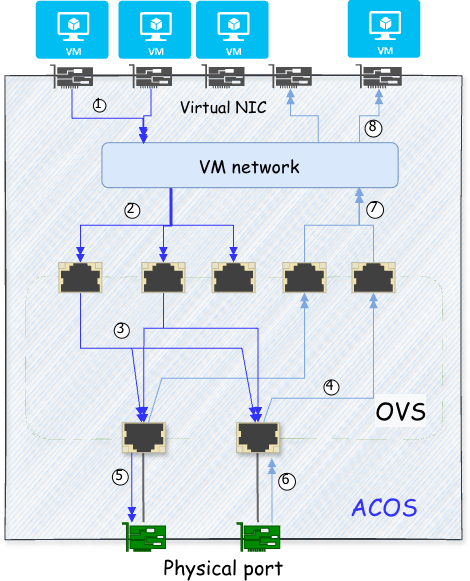
Egress traffic of the VM network
When applications running in a virtual machine send data traffic, the traffic is first processed by the network protocol stack in the Guest OS of the virtual machine and sent to the virtual NIC through the virtual NIC driver. The virtual NIC forwards the traffic through its associated VM network and virtual port to the OVS bridge on the host. The OVS bridge forwards the traffic based on the VLAN configuration and forwarding policy of the port where the VM network resides. Different forwarding paths are used based on different traffic destinations.
The traffic destination is a virtual machine on the same host
The OVS bridge forwards the traffic of the virtual machine to another virtual machine on the same host along the path ⓵>⓶>⓷>⓸>⓻>⓼.
The traffic destination is outside the host where the virtual machine resides
The OVS bridge forwards the traffic of the virtual machine through the physical network port of the host to the physical network along the path ⓵>⓶>⓷>⓹.
Ingress traffic of the VM network
External traffic of the host enters the OVS bridge through a physical network port. Based on information such as the VLAN ID and destination MAC address of the packets, the OVS bridge forwards the traffic through the corresponding virtual network port to the VM network, and the VM network further forwards the traffic to the virtual NIC of the destination virtual machine. The virtual NIC driver of the virtual machine sends the received traffic to the network protocol stack of the Guest OS of the virtual machine for processing, and the processed traffic is then sent to applications in the Guest OS.
The complete traffic forwarding path is ⓺>⓸>⓻>⓼.
