The controller-manager module of the replication service contains a group of controllers that control the state of each resource. After you perform an operation on a resource, the operation can be considered an adjustment to the desired state of the resource. After observing the operation, the controller continuously executes reconcile logic based on the current actual state and desired state of the resource, so that the actual state of the resource eventually reaches the desired state.
The basic execution logic of the replication service is as follows:
After you perform an operation on the AOC UI, AOC UI sends the operation request to AOC Server.
AOC Server sends the operation request to kube-apiserver, and kube-apiserver creates, edits, or deletes the corresponding resource object.
The corresponding controller in controller-manager observes creation, modification, or deletion events in kube-apiserver, attempts to query the latest resource object, runs the corresponding logic, and updates the actual state of the resource object.
AOC Server observes the latest resource object state and displays it on the AOC UI.
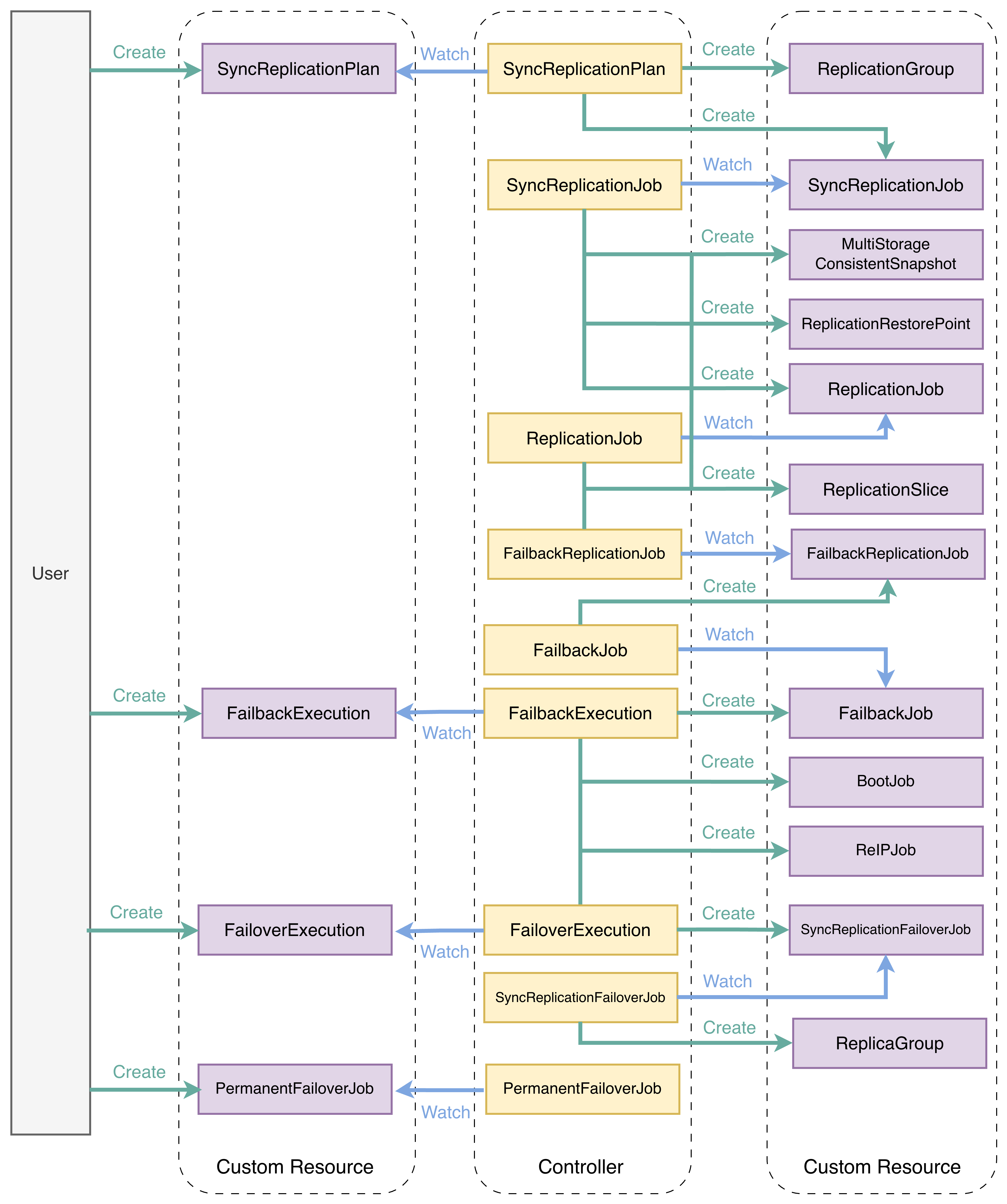
The following example uses the creation process of a synchronous replication plan to describe the basic execution logic of the replication service. Editing and deletion operations follow nearly the same logic.
After you create a synchronous replication plan on the AOC UI, AOC UI sends the operation request to AOC Server.
AOC Server sends the operation request to the kube-apiserver module of the replication service, and kube-apiserver creates a SyncReplicationPlan resource object.
After the SyncReplicationPlan controller in the controller-manager module observes that kube-apiserver has created a new SyncReplicationPlan, it creates a ReplicationGroup resource object for each protected object to be replicated based on user settings. Based on the initialization time, it also creates a SyncReplicationJob resource object at the corresponding time point and triggers the SyncReplicationJob controller to perform related synchronous replication operations.
After AOC Server observes that the ReplicationGroup is created, it displays replication objects on the synchronous replication plan details page and displays the execution status of the synchronous replication job based on the status of SyncReplicationJob.
