You can perform failback on replication objects that are in failover.
In cross-site disaster recovery scenarios, you can initiate failback jobs only from the target site. When the replication service needs to operate on a protected object or replica object, it sends a request to the AOC instance that manages the site where the object resides.
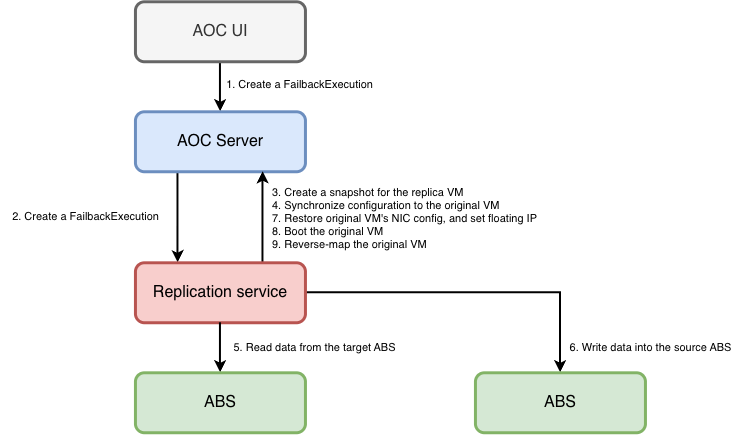
The failback process for failed-over virtual machines is as follows. It is similar to a combination of replication and virtual machine failover:
After you create a failback job on the AOC UI, the frontend sends a request to AOC Server to create a FailbackExecution resource object.
AOC Server sends a request to the replication service to create FailbackExecution.
After the FailbackExecution controller in controller-manager observes that FailbackExecution is created, it creates one or more FailbackJob resource objects. After the FailbackJob controller observes that FailbackJob is created, it creates FailbackReplicationJob to transmit data back to the source. After the FailbackReplicationJob controller observes that FailbackReplicationJob is created, it creates a VM snapshot for the replica virtual machine involved in failback by calling AOC APIs.
The FailbackReplicationJob controller reads the virtual machine configuration information in the VM snapshot and synchronizes the source virtual machine by calling AOC APIs so that its configuration is the same as that of the VM snapshot.
The FailbackReplicationJob controller parses the VM snapshot, obtains the ABS snapshot location corresponding to each virtual disk of the virtual machine, establishes a connection with the corresponding ABS, and starts reading data from the target-side ABS snapshot.
The replication service continuously writes the read ABS snapshot data to the source-side ABS as a stream until all virtual disk data is transmitted back to the source.
The FailbackJob controller restores the NIC configuration of the source virtual machine based on the records in the restore point, and configures VPC floating IPs based on user options.
After the FailbackExecution controller observes that FailbackJob is complete, it creates one or more BootJob resource objects. After the BootJob controller observes that BootJob is created, it waits for the specified boot delay and then starts the source virtual machine by calling AOC APIs.
If VMTools is running in the specified restore point when you create the failback job, ReIPJob is created for the corresponding source virtual machine. After the ReIPJob controller observes that ReIPJob is created, it monitors the startup of the source virtual machine. After the virtual machine starts, the controller configures the VLAN IP address for the source virtual machine by calling AOC APIs.
