After a protected object recovers from a fault, failback can switch service provision from the replica object back to the protected object. During this process, the replica object needs to transfer the configuration information and data that changed while the protected object was faulty back to the protected object to complete data synchronization.
Building a data link
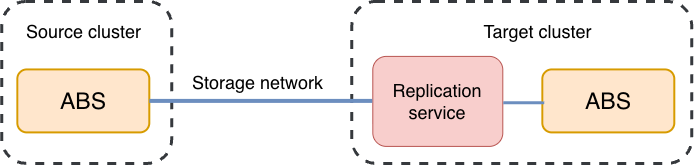
The replication service must connect to both the source cluster and the target cluster through the storage network. This connection is used to transfer configuration and data changes generated during the fault from the replica object back to the protected object. This process is asynchronous replication.
Obtaining the current state of the replica object
The replication service sends a request to AOC to create a snapshot for the replica object and obtain the metadata of the replica object snapshot. The metadata contains the configuration information of the replica object and the ABS volume snapshot, and records the state of the replica object at that point in time.
Synchronizing the replica object configuration to the protected object
During failover, the replica object may have configuration updates while taking over the protected object and providing services. Therefore, to ensure that the protected object can provide services normally after failback, the replication service sends a request to AOC to synchronize the replica object configuration to the protected object.
Replicating replica object data to the protected object
After the protected object configuration information is synchronized, the snapshot data of the replica object is transmitted to the protected object. The replication service compares fingerprints to identify incremental data of the replica object relative to the protected object, and transmits the data to the protected object.
Creating a restore point on the replica object
After transmitting replica object data to the protected object, the replication service creates a snapshot for the replica object as the restore point of replication and uses it as the replication baseline for subsequent protected object data. If the protected object fails again, you can still execute a failover job to start the replica object from the specified restore point state so that it can take over the protected object and continue providing services.
