You can perform failover on a synchronous replication object by selecting an existing restore point or generating a restore point immediately. The two modes follow nearly the same internal flow.
In cross-site disaster recovery scenarios, you can initiate failover jobs only from the target site. When the replication service needs to operate on a protected object or replica object, it sends a request to the AOC instance that manages the site where the object resides.
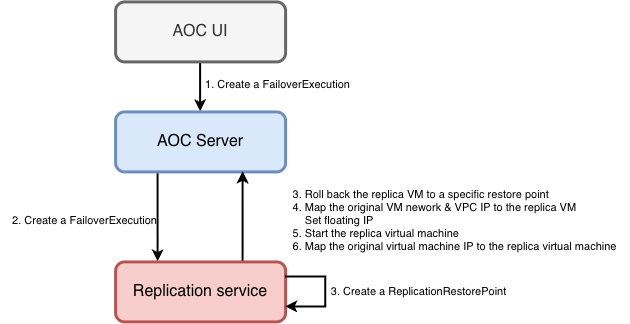
The following is the failover process for virtual machines:
After you create a failover job on the AOC UI, the frontend sends a request to AOC Server to create a FailoverExecution resource object.
AOC Server sends a request to the replication service to create FailoverExecution.
After the FailoverExecution controller in controller-manager observes that FailoverExecution is created, it creates one or more SyncReplicationFailoverJob resource objects. After the SyncReplicationFailoverJob controller observes that SyncReplicationFailoverJob is created, if failover is performed in Generate now mode, the controller creates a restore point based on the current data state of the replica object.
If failover is performed in Select existing restore point mode, the SyncReplicationFailoverJob controller rolls back the replica virtual machine to the specified restore point state by calling AOC APIs.
SyncReplicationFailoverJob performs network mapping for the replica virtual machine and IP mapping for its VPC NICs based on the network/IP mapping rules in the current replication plan, and configures VPC floating IPs based on user options.
After the FailoverExecution controller observes that SyncReplicationFailoverJob is complete, it creates one or more BootJob resource objects. After the BootJob controller observes that BootJob is created, it waits for the specified boot delay and then starts the replica virtual machine by calling AOC APIs.
If you have set IP mapping rules in the replication plan when creating the failover job, and VMTools is running in the specified restore point, ReIPJob is created for the corresponding replica virtual machine. After the ReIPJob controller observes that ReIPJob is created, it monitors the startup of the replica virtual machine. After the virtual machine starts, the controller changes the IP address of the VLAN NIC of the replica virtual machine to the mapped IP based on IP mapping rules by calling AOC APIs.
