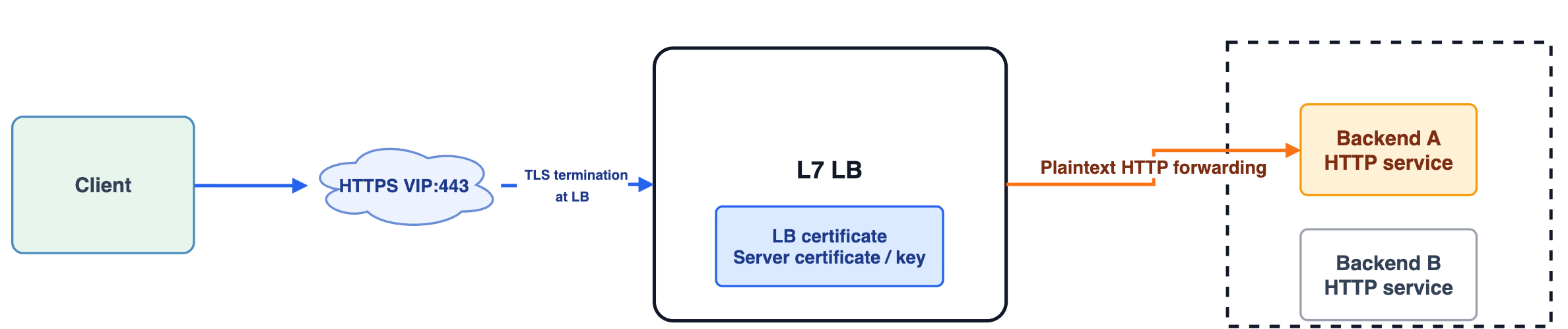
L7 load balancing supports SNI and SSL offloading to perform certificate selection and TLS termination in HTTPS access scenarios.
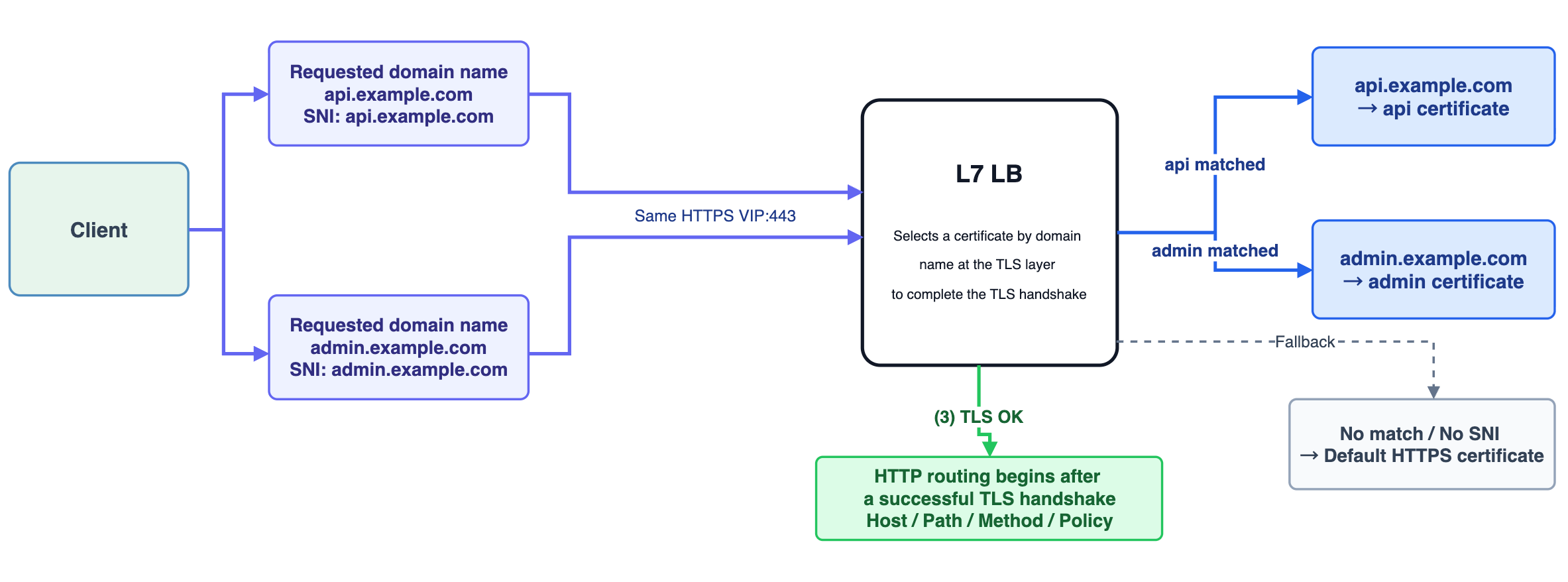
Server Name Indication (SNI) allows clients to declare the domain name they want to access during the TLS handshake. L7 load balancing can select the corresponding TLS certificate on the same IP address and port based on the domain name declared by the client, allowing multiple HTTPS sites to share the same access address.
Currently, SNI is used only for certificate selection at the TLS layer. L7 load balancing selects the server certificate based on the domain name in the client's TLS ClientHello.
As shown below, when clients access the same HTTPS VIP:443, different access domain names carry different SNI values in the TLS ClientHello. For example, accessing api.example.com carries SNI api.example.com, while accessing admin.example.com carries SNI admin.example.com. L7 load balancing reads the SNI domain name at the TLS layer and selects the corresponding certificate. If a request does not contain SNI, or the SNI domain name does not match a configured certificate, the default HTTPS certificate is used.
SSL offloading means that clients and L7 load balancing communicate over HTTPS, and L7 load balancing terminates the TLS connection and decrypts requests before forwarding cleartext HTTP requests to backend servers.
This method is suitable for scenarios where the backend network is trusted, certificates need to be managed centrally, and the TLS processing overhead of backend servers needs to be reduced.