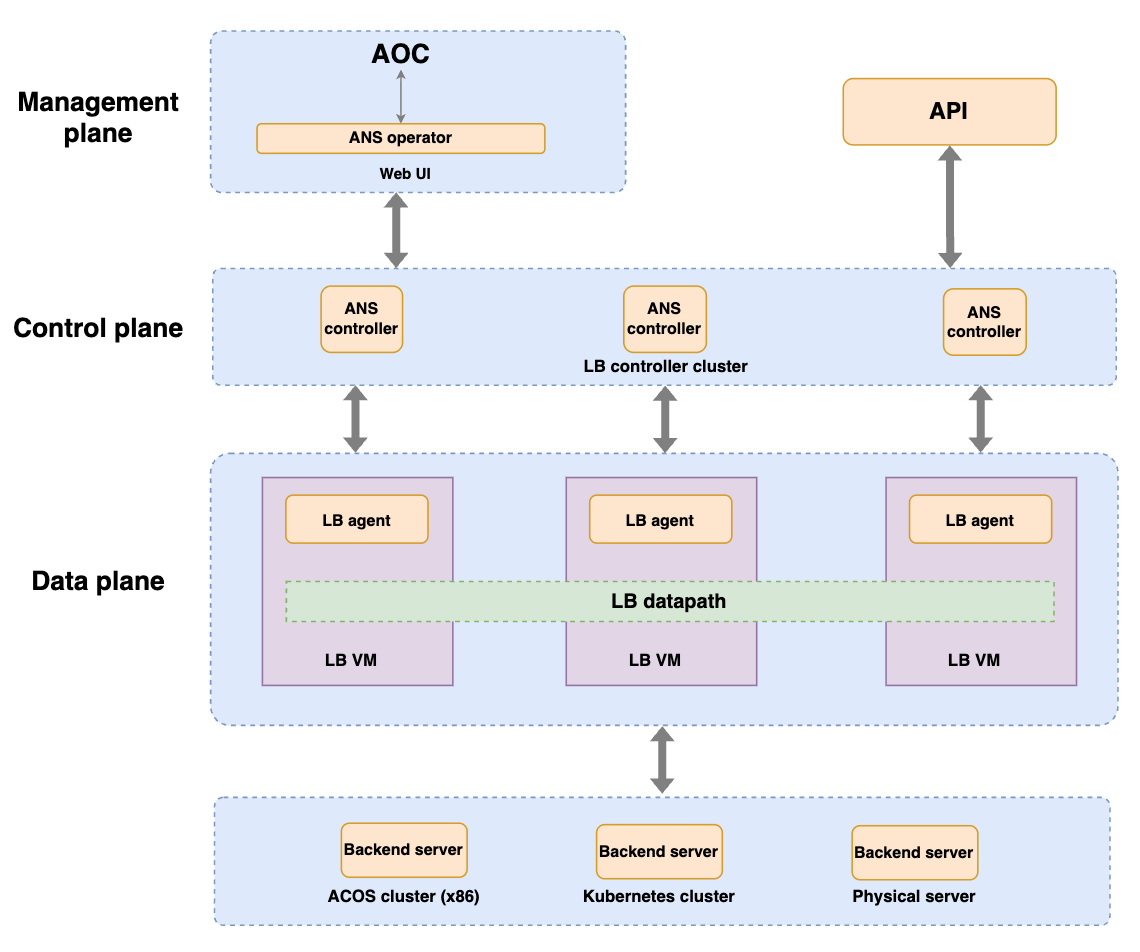
ANS load balancing uses a layered architecture consisting of a management plane, a control plane, and a data plane. The three planes are completely independent and interact through REST APIs or an API server.
This layered design offers the following advantages:
High scalability: Because each plane operates independently and interacts through APIs, you can add more data plane and control plane instances as needed to handle growing workloads.
High reliability: Decoupling between planes ensures that operations management does not interfere with data plane operations. Even during maintenance or configuration changes, the data plane continues to process traffic steadily, ensuring application availability.
High performance: Each plane can focus on its specific task, optimizing overall performance. The data plane focuses on traffic forwarding, while the control plane handles policy decisions and dynamic adjustments to maintain excellent performance under high load.