L7 load balancing supports HTTP and HTTPS. The main difference is whether TLS encryption is enabled between clients and load balancing.
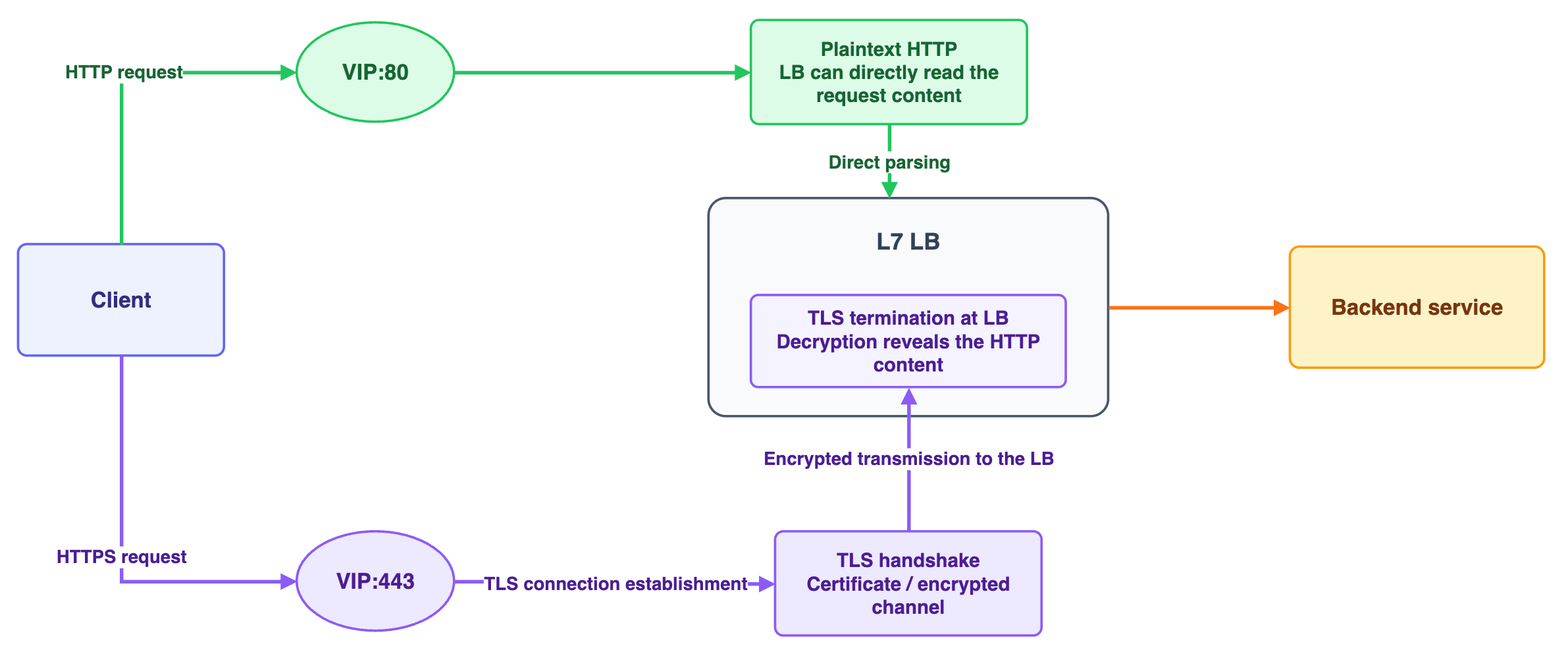
HTTP is a cleartext Layer 7 forwarding protocol. Client requests reach L7 load balancing directly. L7 load balancing can parse HTTP header information such as Host, Path, and Method, select a target server pool based on the forwarding policy and forwarding rules, and forward requests to backend servers.
HTTP forwarding is simple to implement and straightforward to troubleshoot, making it suitable for trusted internal network environments or scenarios that do not require ingress encryption.
HTTPS is an encrypted Layer 7 forwarding protocol. Clients first establish a TLS connection with L7 load balancing. L7 load balancing uses a certificate to complete the TLS handshake and decrypt request content, and then parses Host, Path, Method, and other information according to L7 rules and performs forwarding.
In HTTPS scenarios, L7 load balancing requires certificates to be configured and provides TLS termination. After TLS termination, requests enter an L7 forwarding process similar to HTTP.
