Traffic mirroring duplicates packets that meet specified conditions on a monitored device, such as traffic from a specified port or VLAN, and forwards the duplicate packets to an observation port. When the observation port and monitored device are not directly connected but are connected through a Layer 2 or Layer 3 network, this is called remote mirroring.
ERSPAN has gradually evolved into a standard protocol and is encapsulated based on GRE tunnels.
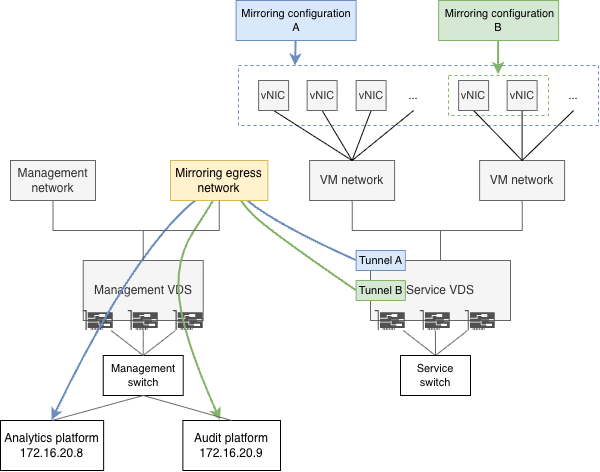
ACOS clusters support Layer 3 remote mirroring encapsulated by ERSPAN. Traffic that meets traffic mirroring configuration rules can be sent to the remote end through the management network or a dedicated mirroring egress network, as shown in the following figure.
Related content: Enabling the virtual NIC mirror mode
