When a protected object is synchronized to a replica object, asynchronous data replication, data synchronization, and configuration synchronization are involved. This process generally includes the following steps:
Building a data link
The replication service must be able to connect to both the source cluster and the target cluster through the storage network. This connection is used for asynchronous data replication from the protected object to the replica object. The source cluster and target cluster must also be able to communicate with each other through the storage network. This connection is used for data synchronization from the protected object to the replica object.
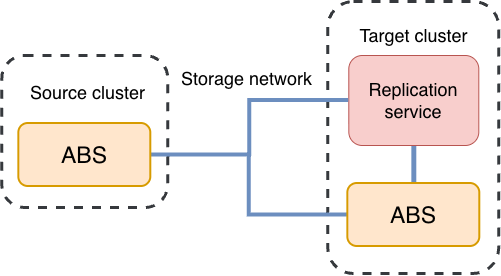
The replication service registers with AOC, and AOC maintains the connection address of the service. You can associate the replication service with clusters on the AOC UI. Before synchronous replication, the source cluster and target cluster must be associated with the same replication service.
Initializing the replica object through full asynchronous replication
During initialization, the replication service performs full asynchronous replication to obtain the current state of the protected object and synchronize its configuration and full data to the replica object, completing the initial creation of the replica object.
Synchronizing the replica object with the protected object
After initialization is complete, the replication service performs data catch-up to ensure that data on the protected object and the replica object becomes consistent. During this process, the system first creates an incremental asynchronous replication job and uses ABS Track to record writes that occur during incremental replication. After incremental asynchronous replication is complete, the system uses ABS Delta Copy to copy the writes recorded during incremental replication until ABS Delta Copy is complete.
Performing ABS dual writes in the synchronized state
After data on the protected object and the replica object becomes consistent, ABS exits the Delta Copy phase and automatically enters Mirror. After ABS Mirror is enabled, ABS performs dual writes on the protected object and the replica object. At this point, the replication object enters the synchronized state. All writes on the protected object are immediately synchronized to the replica object, ensuring RPO = 0.
Creating restore points on the replica object
In the synchronized state, the replication service periodically creates snapshots for the replica object as restore points of synchronous replication. Later, after the protected object fails, you can execute a failover job to start the replica object from the specified restore point state so that it can take over the protected object and continue providing services.
