For users of ACOS (AVE) clusters, when using load balancing, you can choose to deploy an external hardware load balancer or software load balancer. However, using an external load balancer introduces high operational costs and inconvenient maintenance. Therefore, using the integrated ANS network load balancer in ACOS (AVE) clusters is the preferred choice.
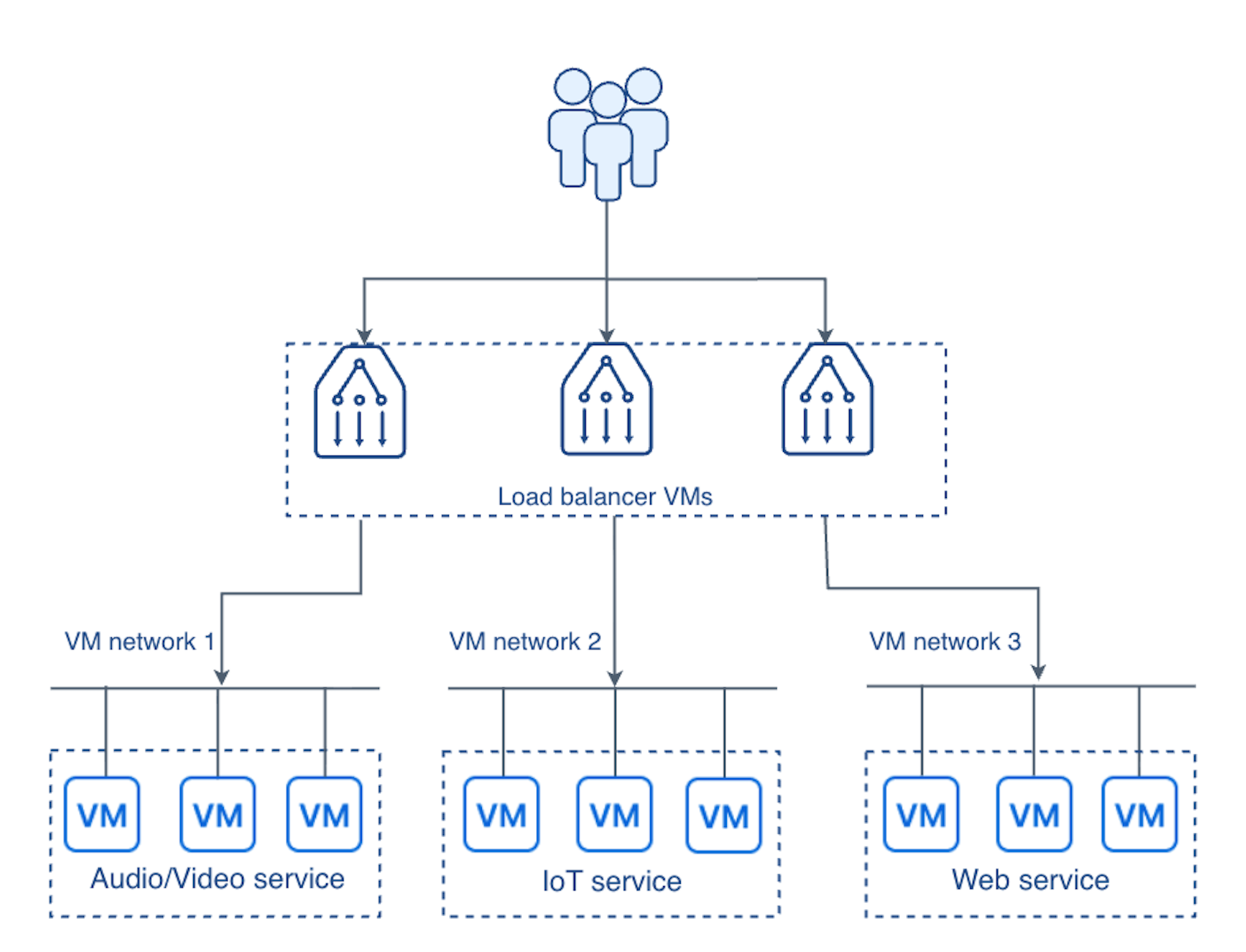
In a virtualization platform, various service scenarios may exist, such as audio/video applications, web applications, and IoT applications. Each service may be deployed in the same or different VM networks, and different application types have specific traffic behaviors, which poses significant challenges to the performance, elasticity, stability, and availability of the overall system. In this case, the network load balancer can be used to distribute service traffic, and backend servers can be elastically scaled to support changes in workloads.
As virtualization technology matures, container technology has become a transformative force with far-reaching impact on the cloud computing field, and an increasing number of users are choosing to deploy applications in containerized environments.
When using load balancing in a containerized environment, the primary options are open-source native LB solutions such as MetalLB. However, open-source native LB solutions offer limited functionality and lack enterprise-level service support, making it difficult to locate and debug issues when they arise.
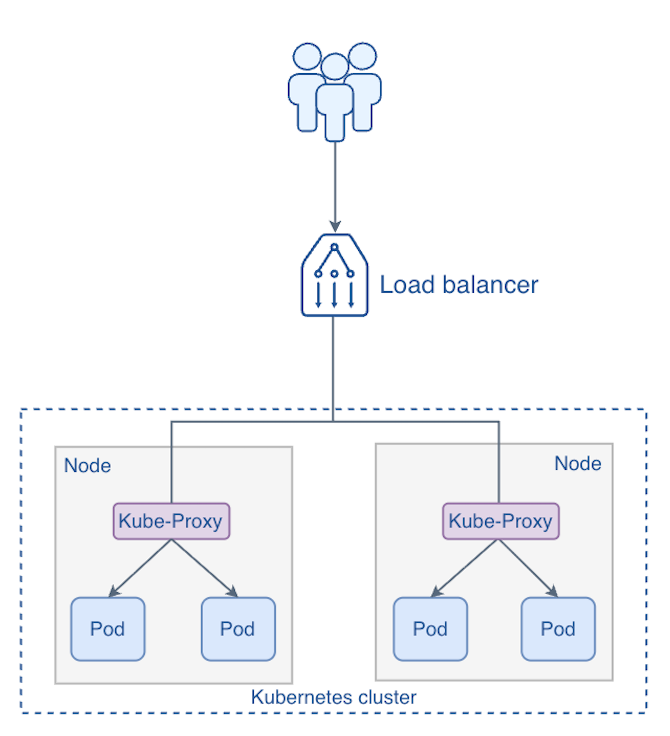
The ANS network load balancer supports L4 load balancing for containerized environments. Whether in a user-built Kubernetes environment or a Kubernetes environment managed by AKE (Arcfra Kubernetes Engine), you can use load balancing features flexibly and conveniently to provide external-facing L4 load balancing for applications within the cluster.
Information:
In the containerized scenario, cluster disaster recovery mode, VPC network scenarios, and server pool groups are not supported.
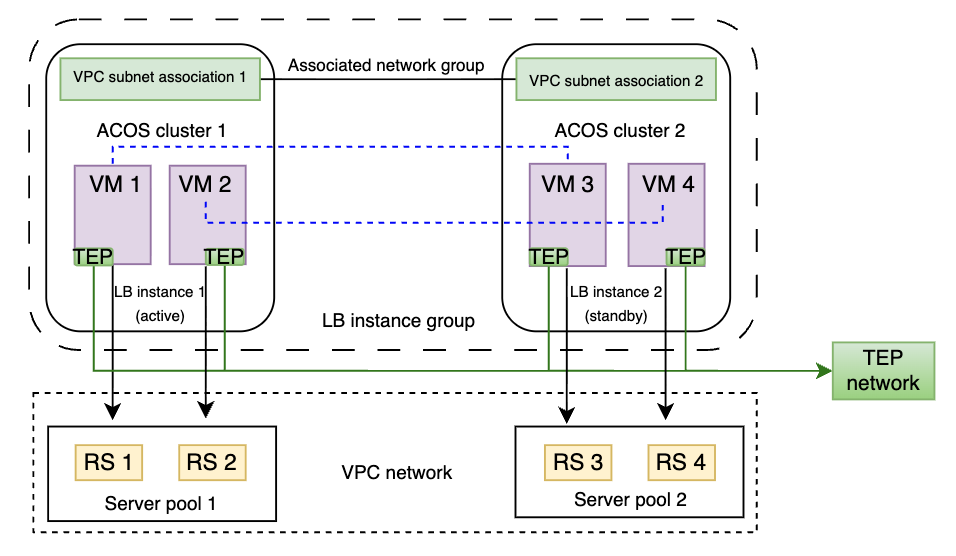
As workloads increase, higher requirements are placed on the high availability of load balancers. The cluster-level load balancer disaster recovery capability of ACOS ensures that when a cluster-level failure occurs, traffic is quickly switched to the standby cluster, ensuring continuity and high availability.
The following figure illustrates the load balancer disaster recovery capability across ACOS clusters in a VPC network. When LB instance 1 fails, all virtual services on LB instance 1 are automatically migrated to LB instance 2 to continue providing services. In addition, you can choose whether to switch the active server pool associated with the migrated virtual services from server pool 1 to server pool 2.