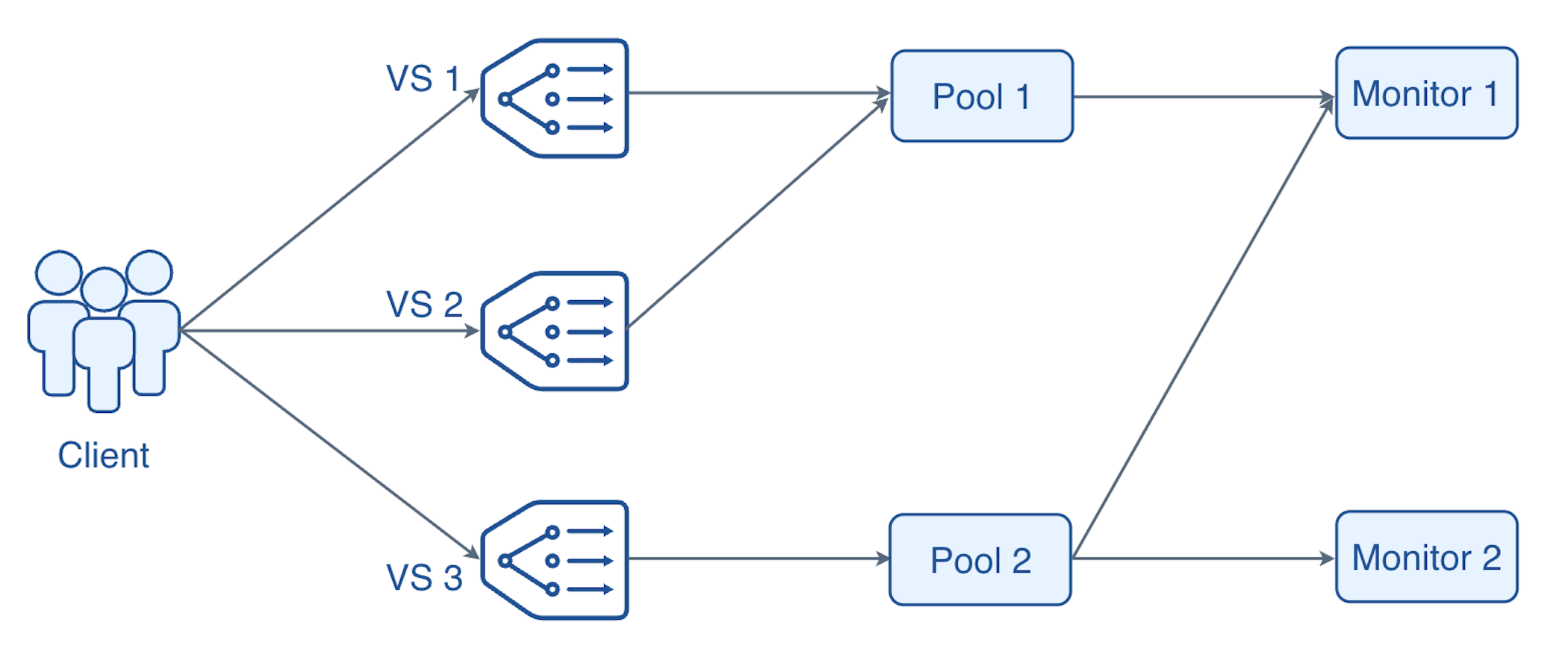
The ANS network load balancer primarily involves the following resources:
Virtual service: Each virtual service typically corresponds to one application. Each virtual service must be associated with a server pool or server pool group. Load balancer virtual machines in an LB instance or LB instance group receive client requests via VIP + port, perform NAT address translation, and then distribute requests to backend servers according to the load balancing algorithm configured in the server pool, achieving traffic load balancing.
Server pool or server pool group: A server pool is a group of backend servers that provide services for an application, responsible for receiving and responding to client requests distributed by the load balancer. A server pool group establishes a primary-secondary relationship between two server pools, with one serving as the primary server pool and the other as the secondary server pool, to provide high availability for backend servers.
Health monitor: Checks the health status of a group of backend servers in a server pool (that is, the members of the server pool).
The figure shows an example of the basic relationships between resources, where "VS" represents a virtual service, "Pool" represents a server pool, and "Monitor" represents a health monitor. A server pool can be associated with multiple virtual services, and a health monitor can simultaneously monitor servers in multiple server pools.