In FullNAT mode, both source address translation (SNAT) and destination address translation (DNAT) are performed. When communicating with backend servers, the destination address is translated from the VIP to the RIP, and the client source address is also translated from the client IP address (CIP) to the LIP.
Use case
FullNAT mode is suitable for scenarios where backend servers do not need to identify the real client IP address.
Network requirement
FullNAT mode has no special requirements for the physical network. You only need to ensure network connectivity, and it can flexibly adapt to various network models.
Address translation process
The following diagram shows the address translation process in FullNAT mode:
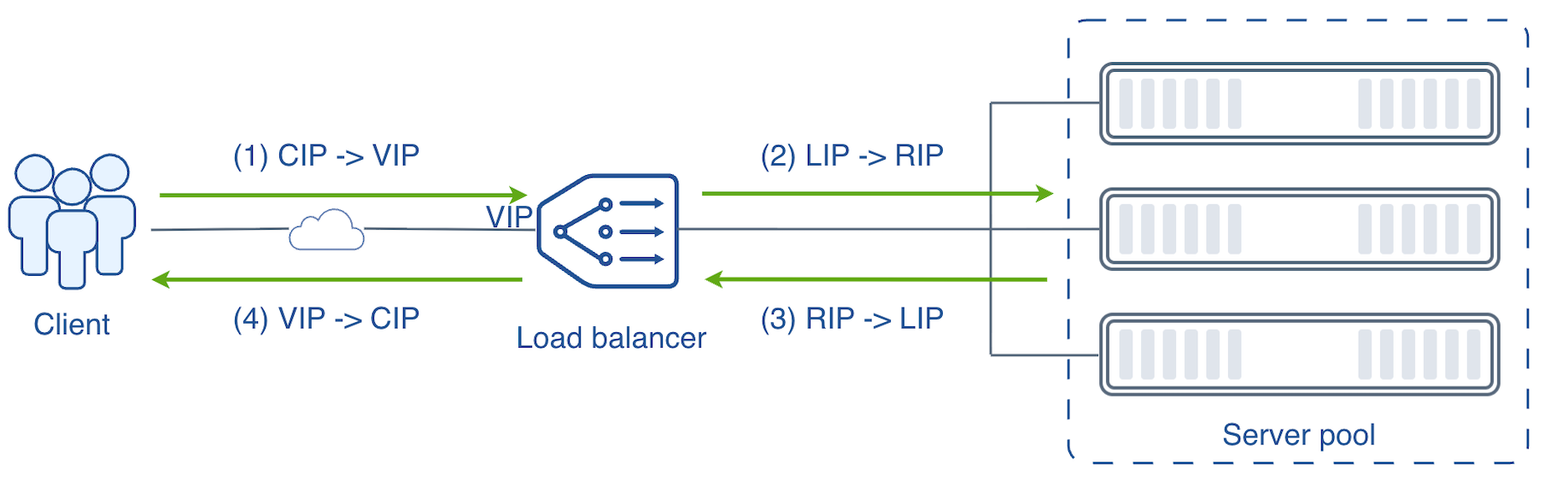
The client initiates a request packet. The source address in the packet is the client IP address (CIP), and the destination address is the VIP.
After the load balancer virtual machine receives the client request, FullNAT translation is performed: the source address is translated from the CIP to the LIP, which is the load balancer virtual machine's address, and the destination address is translated from the VIP to the real IP address of the backend server (RIP). At this point, the backend server is not aware of the real client IP address.
After the backend server receives and processes the request, it sends a response packet. The source address in the packet is the RIP, and the destination address is the LIP.
After the load balancer virtual machine receives the backend server response, the source address is translated from the RIP to the VIP, and the destination address is translated from the LIP to the CIP. At this point, the client is not aware of the real IP address of the backend server.
