The control plane consists of a global control plane and a local control plane, which are decoupled and exchange data through an API server to provide greater flexibility and fault tolerance.
Global control plane: Handles information synchronization, resource management, and configuration management for the load balancing cluster formed by load balancer virtual machines.
Local control plane: Handles configuration conversion, state synchronization, and resource management for the current load balancer virtual machine.
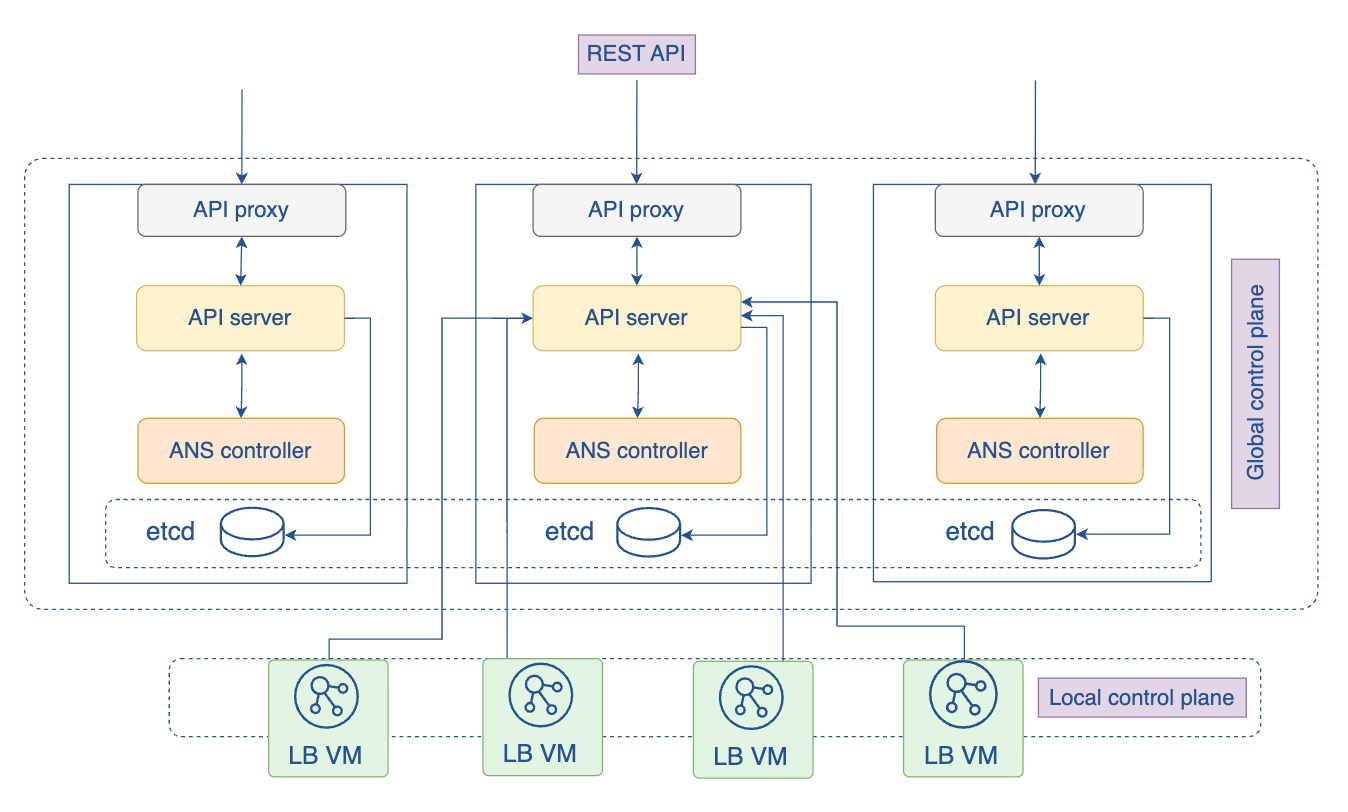
The global control plane consists of an API proxy, API server, etcd, and ANS controllers.
API server and etcd: Core components for communication between the global control plane and the local control plane, and between the global control plane and external systems. etcd stores all cluster data, while the API server is the only component that can interact with the etcd database. All create, read, update, and delete operations on data are completed through the interaction between the API server and the etcd cluster.
API proxy: Provides a unified REST API interface externally, performs data transformation and request routing internally, and ultimately completes interaction with the API server.
ANS controller: Exists as a single-node, three-node, or five-node cluster and handles global information for the load balancing cluster.
The ANS controller processes all configuration information from the management plane, and based on the global information it maintains and current runtime data (such as current cluster resource utilization), determines how to allocate and deploy load balancing virtual services, and then passes this configuration to the local control plane.
The local control plane serves as a bridge between the global control plane and the data plane, focusing only on the current load balancer virtual machine, with good scalability.
The local control plane provides the following main functions:
Listens for configuration information from the global control plane, actively pulls the latest data, generates the current load balancer configuration, and applies it to the data plane.
Monitors and reports the health status of load balancing services and backend servers.
Handles registration and updates for local resources, such as virtual machine status and vNIC status.
