On the AVE platform, ABS provides storage service for virtual machines in the cluster via the iSCSI protocol and vhost. On the VMware ESXi platform, ABS provides storage service for virtual machines in ESXi hosts via the NFS protocol.
ZADP SDK: Integrate directly with ABS volumes using the SDK, primarily intended for scenarios like third-party backup service integration.
iSCSI: Use the iSCSI protocol to access the iSCSI target and iSCSI LUN of the ABS storage object.
vhost: When Boost mode is enabled on the AVE platform, the I/O access of virtual machines to virtual volumes is directly transformed into access to ABS Volume via shared memory.
NFS: On the VMware ESXi virtualization platform, access the ABS through the NFS protocol. Virtual machine I/O access to the virtual volume is converted into NFS file access.
A simplified diagram of a typical ABS access layer that provides virtual disk services for virtual machines is shown below:
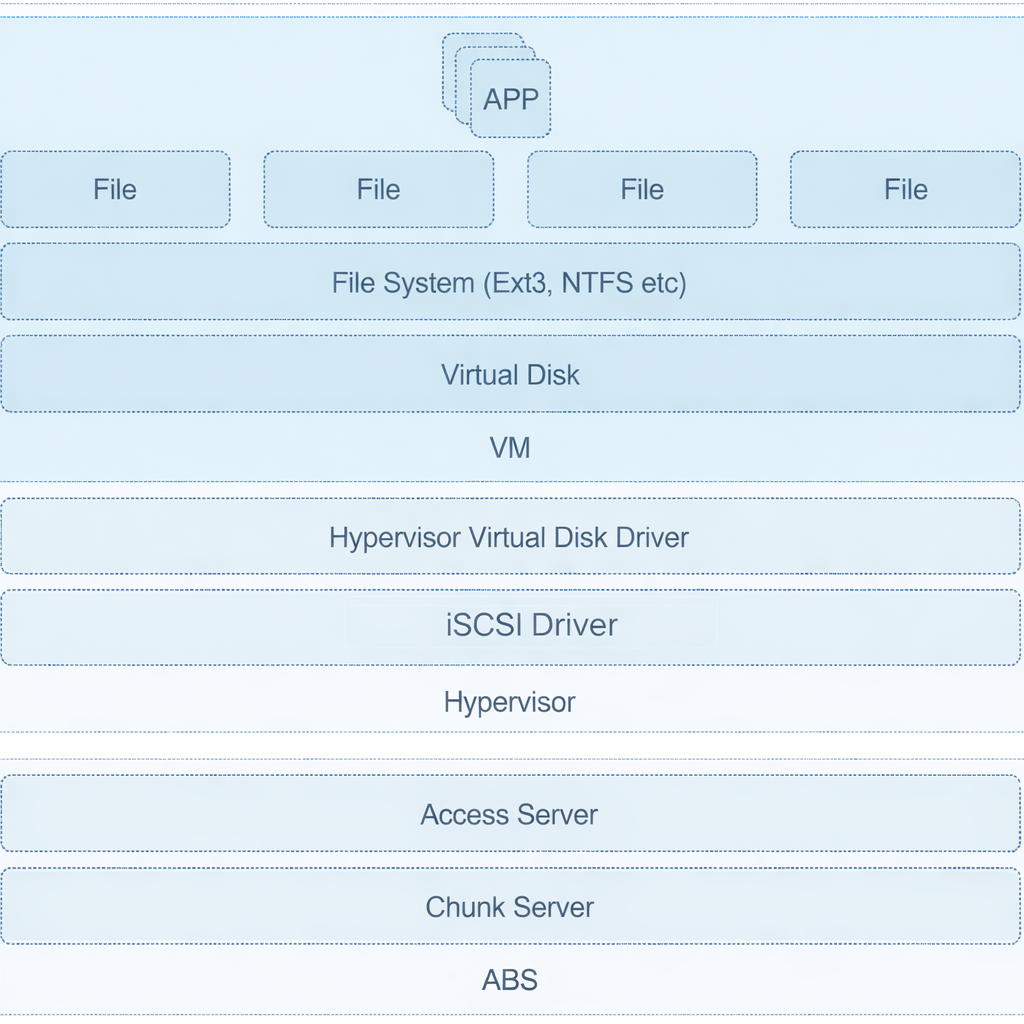
ABS provides storage services to virtual machines in the form of virtual disks. Each virtual disk corresponds to an iSCSI LUN. Applications within a virtual machine access virtual disks through the file system. File operations are first processed by the file system inside the virtual machine, then converted to I/O operations for the virtual disk and passed to the driver layer. The hypervisor's virtual disk driver converts these I/O operations into requests for LUNs, which are sent to ABS Access. Access further converts the requests into I/O operations for ABS data blocks, eventually sending them to the ChunkServer for execution.
