The VPC networking architecture diagram is displayed as follows:
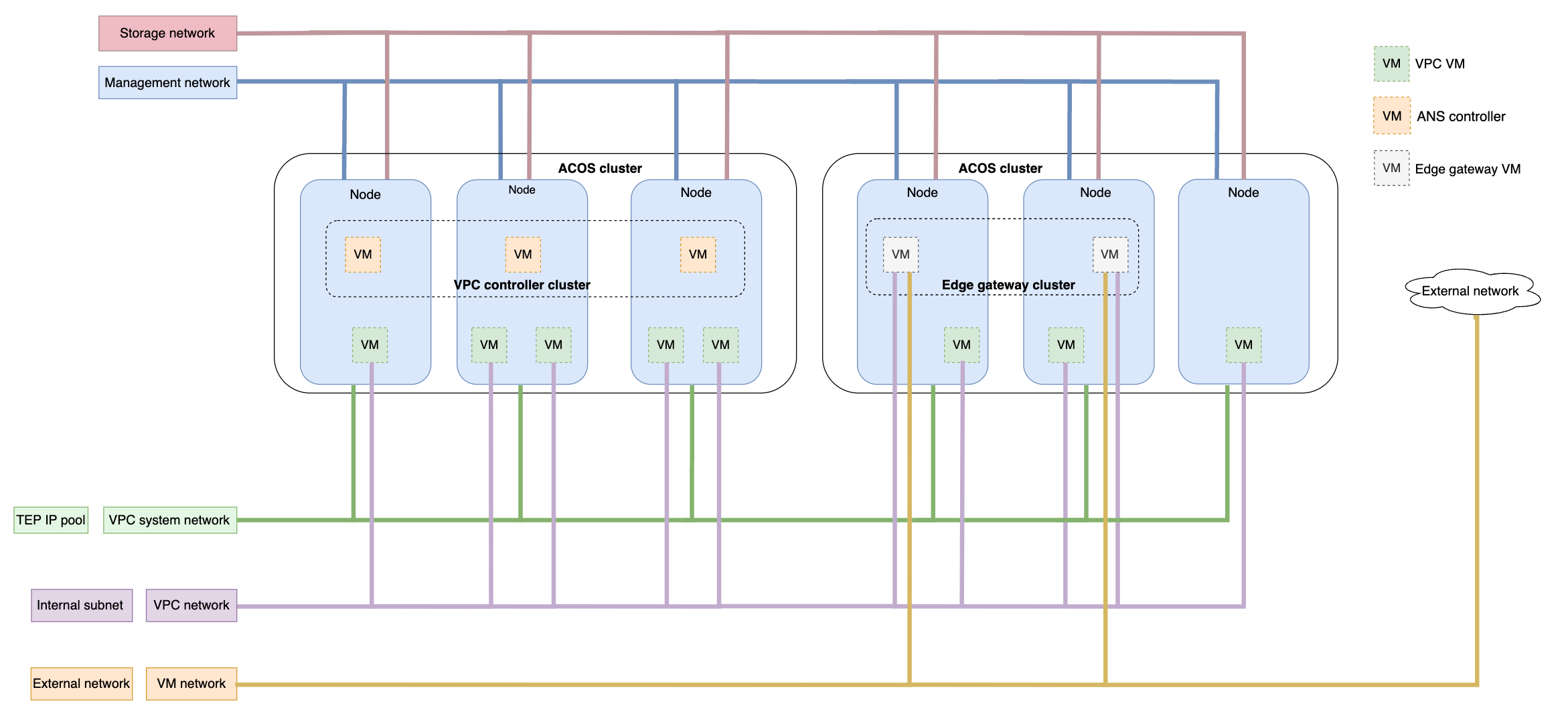
To use the VPC networking feature, you need to plan the internal subnet, TEP network, and external subnet according to the following requirements and recommendations. Before planning, obtain the IP addresses of the management network and storage network of the ACOS HCI (AVE) cluster or ACOS Compute cluster in advance.
TEP IP pool
You can plan the number of TEP IP addresses based on the following condition: Number of TEP IP addresses > (Number of edge gateway virtual machines + Number of hosts in the associated cluster + Number of load balancer virtual machines planned to support VPC networking + 3)
Make sure that the number of IP addresses is sufficient.
Multiple TEP IP pools can be added. Ensure that the addresses in multiple TEP IP pools can communicate with each other.
It is recommended that the addresses in the TEP IP pools do not overlap with the IP addresses of the cluster management network and storage network.
Internal subnet
The default address block is 100.64.0.0/16. You can also apply other address blocks. Ensure that there are sufficient IP addresses to avoid failures in creating gateway services.
Ensure that there is no overlap between the CIDR blocks of the internal subnet and VPC subnets. When you need to use a routing gateway to communicate between a VPC and an external network, ensure that the CIDR blocks of the internal subnet, external subnets, and VPC subnets do not overlap with each other.
It is also recommended that the IP addresses of internal subnets do not overlap with those in TEP IP pools, the cluster management network, and the storage network.
External subnet
It is recommended that the IP addresses of external subnets do not overlap with those in the TEP IP pools, internal subnet, the cluster management network, and the storage network.
It is also recommended to plan the address blocks for NAT gateways and floating IP addresses in advance, while addresses for Layer 2 gateways and routing gateways can be planned later as needed.
When you need to use a routing gateway to communicate between a VPC and an external network, ensure that the CIDR blocks of the internal subnet, external subnet, and VPC subnet do not overlap with each other.
