After an asynchronous replication plan is created, the system automatically executes replication jobs based on the configured replication schedule. You can also execute replication jobs manually. The two execution methods follow nearly the same internal flow.
In cross-site disaster recovery scenarios, you can manually execute an asynchronous replication job from the source site or target site. When the replication service needs to operate on a protected object or replica object, it sends a request to the AOC instance that manages the site where the object resides.
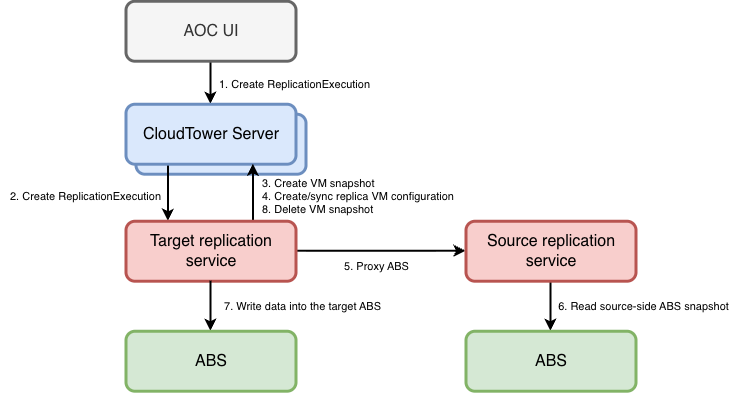
The following steps use manual execution of an asynchronous replication plan for virtual machines as an example:
You manually execute an asynchronous replication plan on the AOC UI. The frontend sends a request to AOC Server to create a ReplicationExecution resource object.
AOC Server sends a request to the target-side replication service to create ReplicationExecution.
After the ReplicationExecution controller in controller-manager observes that ReplicationExecution is created, it creates one or more ReplicationJob resource objects. After the ReplicationJob controller observes that ReplicationJob is created, it creates a virtual machine snapshot for the virtual machine to be replicated by calling AOC APIs. The virtual machine snapshot serves as the data source for this asynchronous replication and the comparison source for the next incremental asynchronous replication.
The ReplicationJob controller reads the virtual machine configuration information in the virtual machine snapshot data, creates or synchronizes the replica virtual machine by calling AOC APIs so that its configuration is the same as that of the virtual machine snapshot, and performs IP mapping on VPC NICs based on IP mapping rules.
The ReplicationJob controller reads virtual machine snapshot data, obtains the ABS snapshot location corresponding to each virtual disk of the virtual machine, and establishes a connection with the corresponding ABS Server through the source-side replication service agent.
ReplicationJob starts reading data from the source-side ABS snapshot through the source-side replication service.
The target-side replication service continuously streams the read ABS snapshot data to the target-side ABS Server until all virtual disks are replicated.
Based on the type and result of the asynchronous replication job, the ReplicationJob controller deletes virtual machine snapshots by calling AOC APIs:
If the current asynchronous replication succeeds, the virtual machine snapshot retained on the source virtual machine by the last successful asynchronous replication job expires and is automatically cleaned up later. The virtual machine snapshot created in step 3 of the current replication job expires after the next asynchronous replication job succeeds.
If the current replication fails, the virtual machine snapshot created on the source virtual machine in step 3 of the current replication job is deleted.
