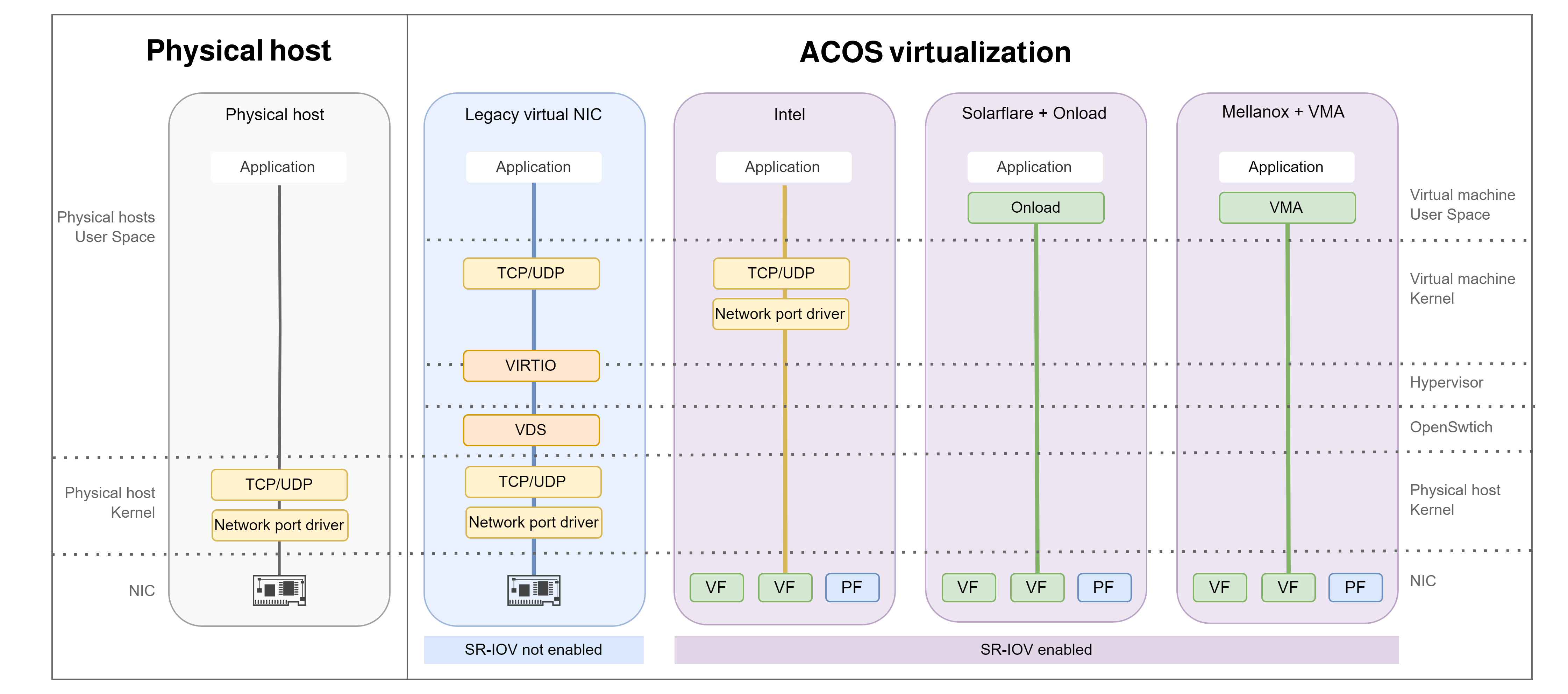
Compared to the traditional virtual NIC, the SR-IOV passthrough NIC has the following features:
It can bypass the virtualization layer, shorten the data transmission path, and achieve network I/O performance close to that of the traditional physical NIC in terms of network latency.
You can use it with low-latency NIC acceleration solutions to bypass the kernel protocol stack and shorten the network packet transmission path. The network I/O latency of virtual machines can outperform the direct physical connections.
Compared to the PCI passthrough NIC, the SR-IOV passthrough NIC has higher scalability.
ACOS supports acceleration features for Solarflare and Mellanox NICs. The details are as follows:
Solarflare NICs: Supports the OpenOnload acceleration solution.
OpenOnload is a high-performance user-level stack that accelerates TCP and UDP network I/O for applications using the BSD socket API.
It is recommended to visit the OpenOnload official website to download the latest OpenOnload release package, and refer to Onload User Guide for installation and usage instructions.
Mellanox NICs: Supports the VMA acceleration solution.
Voltaire Messaging Accelerator (VMA) from Mellanox improves the performance of message-based and streaming applications, such as those found in financial market data environments and Web2.0 clusters. It allows applications written over standard socket API to run over the network from user-space, bypassing the kernel protocol stack to operate on NICs directly.
It is recommended to visit the official NVIDIA website to download VMA and refer to the VMA documentation for installation and usage instructions.
